How a walking day is shaped
· Software in build. Not a safety guarantee.
A walking day is a chain of stops that fits a distance, a clock, and the way you actually arrived. It is not a list of every famous door in a city.
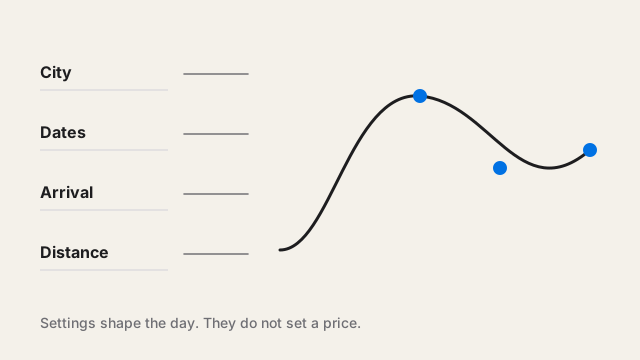
The settings you enter
Wailkingtour asks for a small set of trip settings, and it is being built to read them on the device. You set the city. You set the dates. You set arrival, meaning when you get there, because a day that starts at dusk cannot pretend to be a day that started at breakfast. You set interests, so the stops lean toward what you came to see rather than toward a generic highlight reel. You set a daily walking distance, which is a cap, not a target to beat. You set connectivity, so a day that should not depend on a network can prefer a curated offline route. You set home country and passport country as context on the plan.
Those last two fields are easy to misunderstand, so the boundary is blunt. Home country and passport country are trip settings you choose to keep with the plan. They are not a scan of a document. They are not a visa check, a border decision, or an insurance opinion. Wailkingtour does not tell you whether you may enter a country, how long you may stay, or which queue you belong in. If you need that answer, use an official source. The app is a walking plan, and this website is the explanation of a walking plan still in build.
What the day becomes
From those settings the app builds a day-by-day route on the device and plots stops along it. The route is personalized from the settings without a per-user AI request. Nothing on this page claims that a fresh model call is made for each traveller, and nothing here claims the opposite exaggeration either: that the phone contains every city on earth as a finished guidebook. Barcelona, Lisbon, Rome, and Paris have curated offline routes. A generated day is a day assembled on the device from the trip you set. This site does not promise a curated offline route for every city you can type.
You can open the route in Google Maps. That handoff leaves Wailkingtour for Google's map, which has its own need for a connection and its own account rules. The curated route text for the four cities is the part meant to be readable offline. Street navigation inside Google Maps is not the same promise. Narration is separate again: stop descriptions are spoken with the device's text-to-speech, using a voice on the phone rather than a recording streamed from the studio.
Audio, without a price
The first usable walking day includes narration. Later audio days use consumable credits. Pro unlocks narration for generated days. This website does not name a price for credits or for Pro, because a price would belong to a store, and the software is still in build. There is no purchase button here. There is also no implication that the first day being narrated makes the whole product free, or that a credit is a particular currency amount. Those facts are simply not published.
Shaping the day is mostly restraint. Interests add candidates. Distance removes them. Arrival cuts the hours. Connectivity decides whether you should be looking at a curated offline route in Barcelona, Lisbon, Rome, or Paris instead of a generated day that you hoped to open in Maps. The note on overpacking is the practical version of the distance cap. The product page keeps the full list of behaviors in one place.
A plan can be wrong about a gate, a hill, or a closed door. Wailkingtour does not warrant that a stop is open, safe, step-free, or still where a curator last put it. Use the route as a way to spend a walking day, then look at the street you are actually on. The terms say the same thing as a limitation of liability, not as a slogan.