Choose a city day without overpacking it
· Software in build. Not a safety guarantee.
Overpacking a walking day feels like enthusiasm and behaves like a missed meal. The fix is a cap, a direction, and fewer stops than the city brochure wants.
Start from the cap
You set a daily walking distance because a day without a cap will absorb every interesting thing within an hour of the first pin. Choose the distance you can walk without turning the afternoon into a march. Then let the route respect it. Interests propose stops. Distance disposes of the ones that would break the chain. If you care about three neighborhoods that sit on opposite sides of a river, they are three days, or they are a transport day that this product is not trying to disguise as a walk.
Arrival matters as much as distance. If you land in the evening, the first usable walking day might be a short chain near where you actually are, not a greatest-hits loop that assumes a morning start. Dates tell the app which day is which. They do not tell it that museums are open. A curated offline route in Barcelona, Lisbon, Rome, or Paris is a prepared chain, still subject to the street. A generated day is assembled from your settings on the device. Neither one is a live schedule of ticket windows.
One direction, then slack
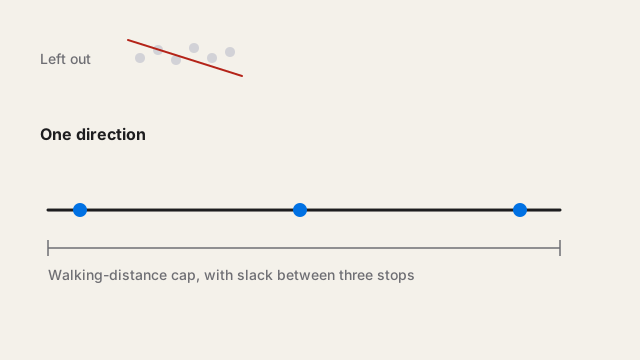
Pick a direction and stay with it longer than feels efficient. Crossing back through the same station so you can tick a second landmark is how a modest distance becomes a long day. Plot the stops in an order you could draw without lifting the pencil, which is what the route line on this site is pretending to be. Then leave slack between them. Slack is how you sit down, how you notice that a stop is closed, and how you abandon a stop without wrecking the rest of the hours.
A good city day often has a dull stretch. Dull is not failure. Dull is the walk that connects two stops without a third attraction shoved into the gap. If you are tempted to add that third stop, read the distance again. The shaping note lists the settings that exist so this temptation has somewhere to lose.
What you should not ask the day to carry
Do not ask it to certify safety. Hills, heat, traffic, crowds, and closures are outside a route plot. Wailkingtour opens a route in Google Maps when you ask it to; it does not become a traffic authority by doing so. Do not ask it for border advice because you typed a passport country. Do not ask narration to be a local friend. Text-to-speech reads the stop description in the device's voice. It does not add facts that were never in the description, and it does not know that a gate moved this morning.
Do not ask the day to impress someone who is not walking it. Overpacking is often a performance for a future retelling. The person who has to walk the extra kilometer is you, today, with the shoes you actually packed. A shorter day with a real finish is a better use of the first narrated walking day than a long day you abandon at stop two. Later audio days spend credits. That is another reason not to generate a pile of speaking days you will not use. Pro unlocks narration for generated days, and still does not require you to fill them.
The product page is the plain inventory of what the software is built to do. The software remains in build. Until you are holding it, you can still use the rule on paper: one city, one distance, one direction, fewer stops, and no promise that the door will be open.